


Earth is the third planet from the Sun, and the densest and fifth-largest of the eight planets in the Solar System. It is also the largest of the Solar System's four terrestrial planets. It is sometimes referred to as the world, the Blue Planet,[21] or by its Latin name, Terra.[note 6]
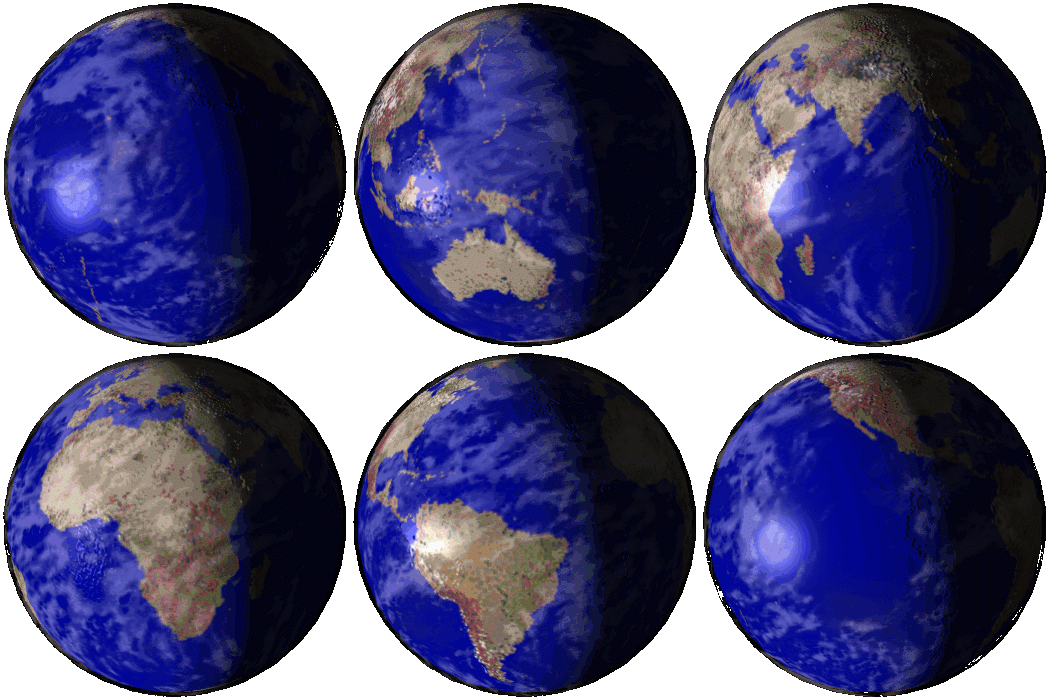 Earth formed approximately 4.54 billion years ago by accretion from the solar nebula, and life appeared on its surface within one billion years.[22] The planet is home to millions of species, including humans.[23] Earth's biosphere has significantly altered the atmosphere and other abiotic conditions on the planet, enabling the proliferation of aerobic organisms as well as the formation of the ozone layer, which together with Earth's magnetic field blocks harmful solar radiation, thus permitting formerly ocean-confined life to move safely to land.[24] The physical properties of the Earth, as well as its geological history and orbit, have allowed life to persist. Estimates on how much longer the planet will to be able to continue to support life range from 500 millionyears, to as long as 2.3 billion years.[25][26][27]
Earth's crust is divided into several rigid segments, or tectonic plates, that migrate across the surface over periods of many millions of years. About 71% of the surface is covered by salt water oceans, with the remainder consisting of continents and islands which together have many lakes and other sources of water that contribute to the hydrosphere. Earth's poles are mostly covered with ice that is the solid ice of the Antarctic ice sheet and the sea ice that is the Polar ice packs. The planet's interiorremains active, with a thick layer of relatively solid mantle, a liquid outer core that generates a magnetic field, and a solid ironinner core.
 Earth interacts with other objects in space, especially the Sun and the Moon. During one orbit around the sun, the Earth rotates about its own axis 366.26 times, creating 365.26 solar days, or one sidereal year.[note 7] The Earth's axis of rotation is tilted23.4° away from the perpendicular of its orbital plane, producing seasonal variations on the planet's surface with a period of onetropical year (365.24 solar days).[28] The Moon is Earth's only natural satellite. It began orbit about 4.53 billion years ago. The Moon's gravitational interaction with Earth stimulates ocean tides, stabilizes the axial tilt, and gradually slows the planet's rotation. Between approximately 3.8 billion and 4.1 billion years ago, numerous asteroid impacts during the Late Heavy Bombardment caused significant changes to the Moon's greater surface environment.
 |
Both the mineral resources of the planet and the products of the biosphere contribute resources that are used to support a global human population.[29] These inhabitants are grouped into about 200 independent sovereign states, which interact through diplomacy, travel, trade, and military action. Human cultures have developed many views of the planet, including itspersonification as a planetary deity, its shape as flat, its position as the center of the universe, and in the modern Gaia Principle, as a single, self-regulating organism in its own right.

No comments:
Post a Comment